
Lumia 910
24/08/2012 13:16 par slaytane


24/08/2012 13:16 par slaytane
Jonas Daehnert, the designer who created the beautiful Surface Phone is now back with a Nokia Lumia 910 teaser. This phone has remarkable finesse, a metallic case and an interesting choice of colours, that makes me think about autumn.
Also, the device is less rounded than previous Lumias and much thinner. Nokia Lumia 910 features a 4.3 inch screen without the black screen frame and it’s very, very thin at 6.8mm in waistline. The handset is very compact and its body is made of aluminum. Jonas didn’t detail other specs, since frankly they don’t matter. Windows Phone 8 Apollo runs on multicore CPUs and that’s all you need to know. Pureview is seen by the designer as a good technology, but one that makes the phone ugly.
As I said, the finesse of the phone is great and I like the bigger camera button, as opposed to the smaller camera key that we also saw on the Nokia Pureview 808 handset. I suppose the smartphone has a soft touch area at the bottom, with those Windows Phone keys, that are most likely touch only. So, do you dig this model?

27/07/2012 20:03 par slaytane
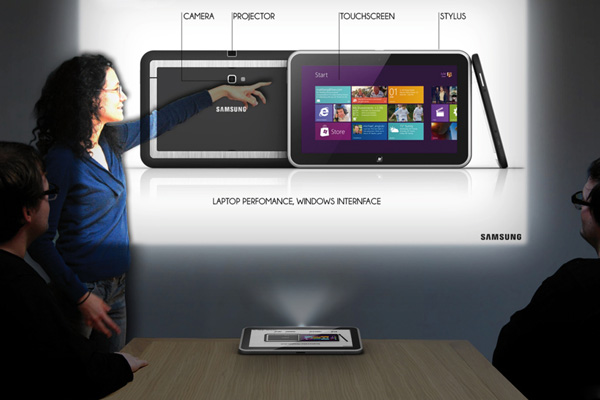
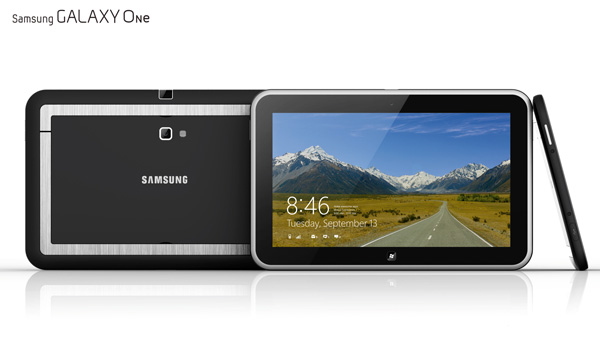
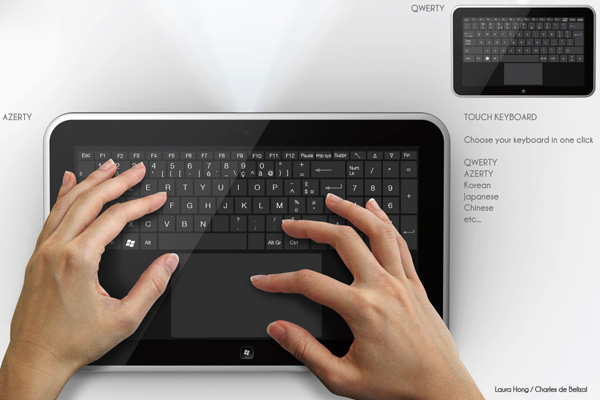
Samsung has a projector phone or two in its portofolio, but what about tablets with projectors? That hasn’t been done by any company as far as I know, so the market is open. Laura Hong and Charles de Belizal envisioned a projector tablet and called it the Samsung Galaxy One, that you can see below.
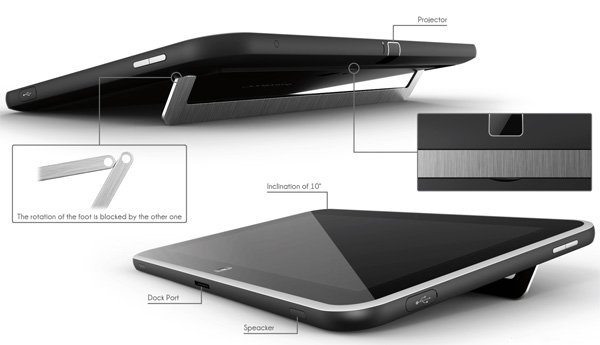
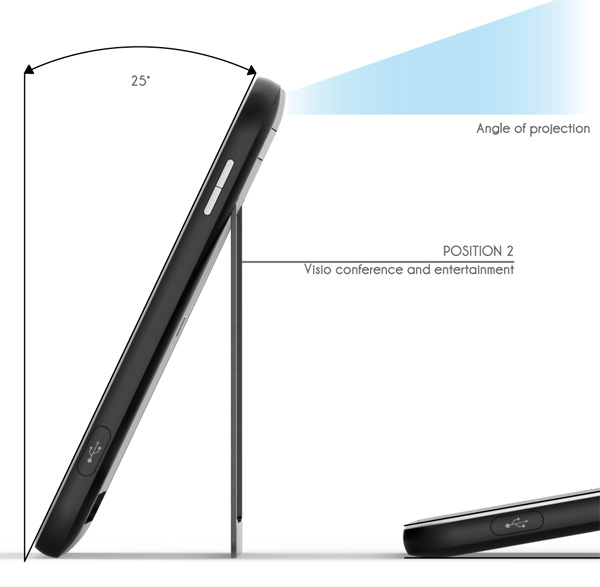
This device measures 14mm in thickness, packs a projector, Windows 8, an aluminum body and brushed aluminum feet. The Galaxy One has two “feet”, that help prop it up in media viewing position if you want to watch movies and also prepare it to project data during a business meeting, for example. It has a great projection angle and the projector is incorporated right above the camera sensor, that also includes a flash. A stylus is also in the mix and the Metro UI seems to fit right in with this Samsung tablet concept.
The virtual QWERTY keyboard also looks comfortable and I guess it’s part of the design, since it doesn’t resemble the standard input method in Windows 8. From what I can see here, the projector can rotate depending on the position you want it to assume, while using the tablet to show stuff at a meeting. The stylus is small and discrete and also reminds me of the S Pen a bit. Since this is a Windows 8 machine I imagine it would cost quite a bit… how much would you spend for it?

27/07/2012 20:01 par slaytane
Well, since the first Galaxy Note was actually a bigger Galaxy S II, why wouldn’t the Samsung Galaxy Note II be a larger Galaxy S III? The new design you see here comes from Bob Freking, who I asked to imagine the next Galaxy Note and this is what came out.
We’ve got a smartablet with rounded edges, front camera, potent camera at the back, stylus and elongated Home button. It’s also a pretty wide device, so the diagonal may even increase. Samsung Galaxy Note 2 features a quad core Exynos 1.8 GHz processor, but it may also be that new ARM Cortex A15 chip they’re developing right now. An increase to 5.5 inches is also expected by Bob Freking, as well as a jump to 1080p HD AMOLED screen or maybe even a higher resolution.
Galaxy S III comes with the nature-based UX, so I guess the same idea would come here, but with a twist associated to the S Pen, or maybe the S Pen II. You know what would be extremely cool? If the stylus was also a headset, like on the ASUS PadFone, or even cooler: a thicker stylus with AAA batteries, that serves as pico projector. How do you like that?

27/07/2012 19:59 par slaytane
If you’re looking into the future and searching for the Samsung Galaxy S IV handset, then Alexander Black may have an insight into that. He teased you all a couple of days ago and now it’s time to unveil… the Samsung Galaxy Aurora. The project is not done, since he plans to mix Android 5.0 in this piece of work and some modular stuff.
A follow-up project is also coming. As far as the Samsung Galaxy Aurora is concerned sees when you’re resting your eyes and goes into auto sleep mode. It also comes with a reliable assistant, the S Voice function that works beautifully. The handset will also “know” you’re at the movies and silence itself automatically. Its screen is heat resistant and the new Galaxy model packs a rotating 12 megapixel camera, available for all the angles of stunning photos you can imagine.
There’s also a holographic 3D function, that’s showcased in the last image below and it looks like a real battery drainer this one. Galaxy Aurora knows your touch by the heat you emanate and finally here are some more features to feast on: quad core 2 GHz processor, wireless router chip build in, 4G connectivity, 35 mAh rechargeable battery (does he mean 3500 mAh?) with 20-22 hours of talk time. To me this model looks like a combo between the Nokia N9 and a more rectangular Samsung Galaxy Nexus, if you want. What do you say?


[Thanks Alexander Black!]

27/07/2012 19:57 par slaytane
If you haven’t heard about Antoine Brieux/NAK Studio, it’s a real shame, since he’s a talented designer and I suggest you click his name and check out his work on our website. Now he has a fresh concept for us, the Galaxy Nexus Black S, a beautiful render that shows us how the future of Google phone flagships may look like.
It’s a pretty wide device, that packs a big 4.9 inch Super AMOLED+ display with 720p resolution and runs Android 4.0 ICS. It weighs 153 grams, measures 8.43 mm in thickness and also offers HSPA+, WiFi, Bluetooth, 32/64GB of storage, plus a 2050 mAh battery. The brain of the Galaxy Nexus Black S is a 1.4 GHz quad core processor, maybe an Exynos, maybe a future Snapdragon from Qualcomm. NFC, an accelerometer and a buttonless design fill in the blanks here, as well as 1.5GB of RAM, a plunge that no company has dared to make on the memory side so far.
The case is all aluminium unibody and you’ve got a virtual SIM card with PC adaptor included (not sure what that means). There’s a 12 megapixel camera at the back with continuous autofocus and a 3.2MP sensor upfront for videocalls. The standard 3 capacitive buttons are placed below the display and the case is slightly curved, just like the Galaxy Nexus unit from 2011. The side area of the handset reminds me a bit of the Xperia Play, if I may say so. It’s got a great metallic look that everyone will love.


27/07/2012 19:55 par slaytane
The most prolific designer we’ve had on this website for years, Bob Freking recently read a piece on Phone Arena about the upcoming Samsung Espresso 10 and Espresso 7 tablets, that are supposed to launch in June. He then proceeded to design a bunch of renders to fit the newcomers. You can check them out below:
Bob wants Samsung to “battle in the high end segment” and not be happy with the lower end one. He imagines an Exynos 5 A15 processor will be on board, as well as an improved camera, to finally get rid of all those poor 3MP sensors on the latest Sammy slates. The designer wants an 8 megapixel camera this time, the same sensor on the Galaxy S II, plus a case that’s as thick as the one of the Galaxy Tab series and Android 4.0 ICS as a must have feature. Expandable storage, 4G LTE and 3G are also available.
Bob pictures the Samsung Espresso 10 and Espresso 7 as having a 2560 x 1440 resolution, that beats the one on the iPad 3 and gives the tablets a 290 ppi status. Finally, the designs came with some prices associated, such as a minimum of $399 for the 10.1 inch Espresso tablet with 16GB of storage and WiFi. Add to that 3G and the price goes to $449, add 4G and it’s $499. The 7 incher 16GB Espresso goes for $299, but once again these are merely speculations!

[via Bob Freking]
After yesterday’s showcasing of the Motorola Nexus RAZR concept, we have another Android 5.0 phone on our hands. This Jelly Bean device has been created by Hasan Kaymak and goes by te name Samsung Galaxy Nexus+. The device features a 4.5 inch Full HD display and a quad core processor.

There’s also an 8 megapixel camera on board, Google Voice+, a feature that’s just like Siri (or even better) and some extra UI functions. For example, the designer imagined an editable Status Bar, Dock (color, style, icons) and also a tweakable Menu style. From what I can see, the design is not totally different from the Samsung Galaxy Nexus, since it’s a Plus model afer all, like the Galaxy S II Plus and Galaxy S Plus. This means that it only adds a minor improvement or two.
In this case the improvement is particularly the CPU and mainly the camera, something that people complained about on the original Galaxy Nexus, that only had a 5Mp sensor. Android 5.0 Jelly Bean looks nice and keeps very much of the Android 4.0 design styling, so I can’t really figure out any design additions. The back button looks a bit modified, unless I’m mistaking…


27/07/2012 19:37 par slaytane
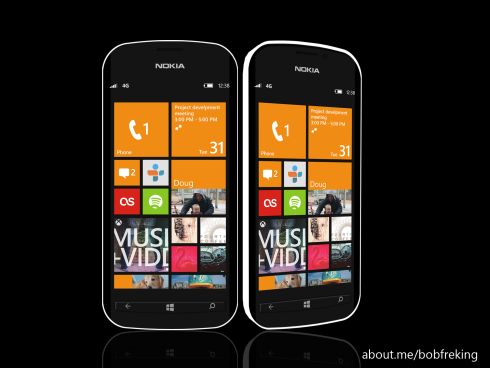
Time to explore Nokia Windows Phone design formats again thanks to Bob Freking, who showed us one of his latest concepts, the Nokia Phoenix. He claims that he likes the PureView phone quite a bit, but he wishes it was thinner, at least 10mm. So, he created a Windows Phone 8 dual core handset with Pureview camera on board.
Bob says that Nokia has the habit of recycling designs, so it wouldn’t be a surprise if one of the first Windows Phone 8 units was based on the PureView 808. Nokia Phoenix features a 31 megapixel camera, a 10 mm thick chassis and this is the first model made by Finns with a 4 inch HD ClearBlack AMOLED display with a density of 367 ppi. This model runs Windows Phone 8 Apollo, features 2GB of RAM and is able to record 1080p full HD video. Also, another premiere: this is the first Nokia smartphone with a dual core ARM15 processor.
As you can see there are smaller tiles on the screen, the new sizes that WP8 brings. This design involves rounded edges and a “band” with keys on it, that feels like a physical button area rather than capacitive. Since this device has a 31MP camera, I wonder what the maximum resolution of photos is…

27/07/2012 19:35 par slaytane
Bob Freking is back with a fresh design, the one of the Nokia Clarity handset, the first Windows Phone 8 concept since the announcement of the OS this week. The phone combines Metro UI with the latest OS features and a PureView camera. As you can see, we those smaller tiles included in the Metro UI, plus a clearer interface and apparently some way to make the UI transparent.

The phone is a pretty long and wide one, so I wouldn’t be surprised if it were a 4.7 inch unit. It’s also pretty rounded at the corners and I guess that its screen is a 720p unit. Inside there should be a dual core Qualcomm CPU, unless it’s a quad core, for that extra processing power needs of the PureView camera. Nokia Clarity also supports LTE connectivity, has a 20+ megapixel camera with PureView tech, 64GB of storage, a 2MP front camera, NFC and a 2500 mAh battery.
These are all my speculations that follow the design of Bob Freking, so feel free to take them as a figment of my imagination. I think that this design is pretty good since it manages to deliver a rectangular phone with great width, rounded corners, crisp display and PureView camera, plus WP8 on board. How much would you pay for it?


27/07/2012 19:33 par slaytane
A while ago we brought you the Nokia Lumia Evolution concept phone, created by LokiBartleby and now he’s back with more pictures and another Nokia design. The handset you see here below is called the Nokia Lumia Elements. Also, at the end of the article you’ll see two new pics of the Lumia Evolution.
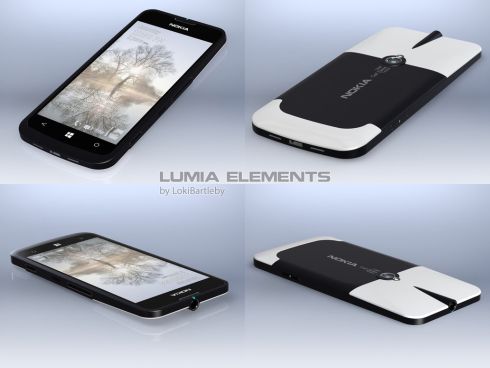
As far as the newcomer Nokia Lumia Elements concept is concerned, this model features a 4.3 inch 720p AMOLED CBD display, an aluminum unibody + polycarbonate case with ceramic-like finish and Windows Phone as OS. At the back there’s a 12 megapixel camera with Carl Zeiss lens. The main idea of this Nokia concept is to get some metal into the Lumia series, that seems to focus on plastic materials. As far as the elements go, I find it very cool, especially the back side and especially the audio jack, that looks like the barrel of a gun.
At the front the device looks like a more modern Symbian device and it’s not that far from Nokia 808 PureView actually. Nokia Lumia Evolution seems more plasticky, has a pretty big speaker at the inferior side and a very pretty glassy and glossy facade. Which one do you fancy more?
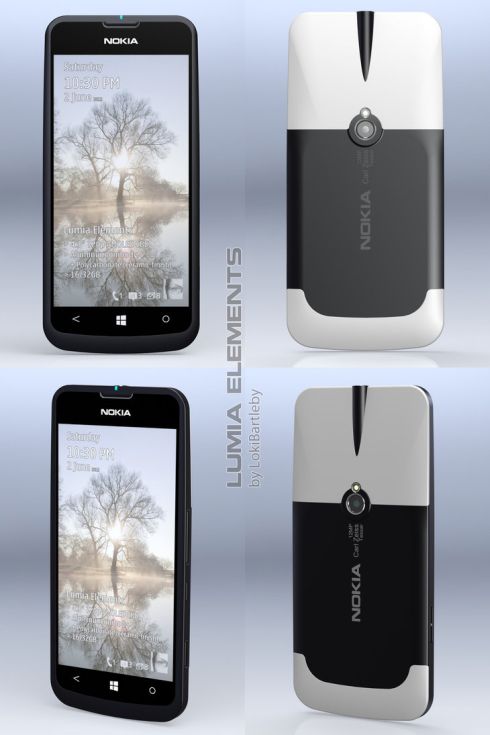


And here we are with a brand new Nokia Windows Phone concept, the Lumia Evolution, that seems to feature a camera with a dual flash. This is a Windows Phone 8 Apollo model with a pretty thin waistline and somehow it reminds me a bit of the Nokia Lumia 710, although I hope it swapped its plastic back for metal.
The interesting bit is the lower side where the speaker is and the cute little audio jack with teh rounded segment around it. Also, notice how the Home button with the Windows symbol has evolved. As far as the hardware of the Nokia Lumia Evolution goes, we have here a 4.5 inch HD screen, 64 GB of internal memory and most likely a dual core CPU made by Qualcomm. Intel could also be part of this initiative, but I’m not sure they’ll be ready with a good enough CPU to use on a phone meant to sell millions of units.
AT the back I expect something like a 12MP camera with PureView technology, maybe some 4G LTE, NFC and the latest in Bluetooth and WiFi tech. This concept looks pretty realistic and it’s finally a break from all those Nokia N9 copycats… Do you like it? This concept was created by Deviantart user LokiBartleby.