
Vivid
15/12/2011 15:43 par slaytane


15/12/2011 15:43 par slaytane

HTC's been around this block before -- the LTE one, that is. Back in March, the manufacturer was the first to hold Verizon's hand as it tested the 4G waters with the Thunderbolt. That launch may have been fumbled (see: hotspot cycling and 3G connectivity for starters) and the device plagued by battery issues, but as far as head starts go, Big Red got a big leap. Now the time has come for AT&T to play catch-up, shedding its reliance on an HSPA+ faux-G crutch and shifting over to LTE wireless speeds.
To do this, the carrier's enlisted HTC's veteran expertise, taking advantage of its 700MHz know-how and offering the manufacturer a redemption song of sorts. This round two redux takes the form of the Vivid: an all-black, metal-backed unassuming plastic slab that houses a dual-core 1.2GHz processor and 8 megapixel rear camera with dual LED flash under a 4.5-inch qHD display. Impressive as its specs may be, AT&T's not betting the entire farm on this phone and is trotting out the Samsung Galaxy S II Skyrocket alongside to shoulder the burden. But for a device once codenamed the Holiday, its battle for consumers' attention and disposable dollars could prove to be anything but leisurely. Will LTE history and its battery draining missteps repeat themselves? Can AT&T get a leg up on its first place competition with this $199 device? And is the allure of "true" 4G even worth your hard-earned dollars? Follow us after the break as we find out.


Whip this phone out in public and you're not likely to attract much attention. That's because, much like a mullet, HTC built this beast to be all business up front and a party (however lame and unattended) in the back. AT&T's logo is really the only splash of flash your eyes will be treated to, located as it is just beneath the Vivid's imperceptible sliver of an earpiece, with the front-facing 1.3 megapixel VGA camera flanking it to the right. Swallowing up the majority of the phone's face is that 4.5-inch 960 x 540 qHD TFT Super LCD display and it's a knockout. True, you'll encounter a certain degree of difficulty reading this screen in strong sunlight, but take it indoors and you'll notice an ample brightness to the crisp display that delivers well-balanced contrast and excellent viewing angles. Colors reproduced on the handset belong neither to the over-saturated Super AMOLED realm nor the just-so quality of an IPS display, falling somewhere comfortably in between.HTC built this beast to be all business up front and a party (however lame and unattended) in the back.
| Vivid | Galaxy S II Skyrocket | Droid RAZR | |
| Quadrant | 2,005 | 3,035 | 2,798 |
| Linpack (single-thread) | 44.9 | 49.7 | 50 |
| Linpack (multi-thread) | 38.9 | 70.1 | 95.66 |
| Nenamark1 | 43.7 | 59.8 | 50.34 |
| Nenamark2 | 30.1 | 54.2 | 27.54 |
| Neocore | 58.3 | 57.2 | 59.98 |
| SunSpider 9.1 | 4,540 | 2,739 | 2,140 |
We put the Vivid through its fair share of benchmark testing and brought along Motorola's Droid RAZR and AT&T's other LTE flagship, the Galaxy S II Skyrocket, for a handy comparison. We weren't surprised to see HTC's black beastie repeatedly fall behind the 1.5GHz Skyrocket, but we certainly didn't expect a 0.3GHz difference to forge such a drastic gap in Quadrant scoring between the two. It's hard to say what the culprit is, but if we had to guess, we'd point our finger at Sense and the amount of pixels rendered on the Vivid's qHD screen versus the Skyrocket's WVGA. The Vivid's consistent loss to Moto's similarly clocked beastie and its TI OMAP 4430 processor also caught us off guard. Despite multiple trial runs in each category, the Vivid claimed no title, but that of last place performance.It's hard to say what the culprit is, but if we had to guess, we'd point our finger at Sense and the amount of pixels rendered on the Vivid's qHD screen


Shaik Imaduddin sent us a couple of Nokia Windows Phone concepts, that are shown in the video below. There’s also a pic he sent us, the one of a device he calls the Nokia Lumia 850. It reminds me a bit of a larger Nokia Lumia 800 or the Nokia Lumia 900 if you want, with a touch of Samsung Omnia 7.

This is a Windows Phone 7.5 Mango device that probably packs a 4.3 inch display, a 1.4GHz single core processor and an 8 megapixel camera at the back. There’s also a camera button in here, on the side and the layout of the keys is similar to the Lumia 800. Considering the model name, I’m expecting slight upgrades of the handset, maybe in the camera section, maybe in the internal hardware. I see that people commenting on the video below were pretty harsh, which is no way to treat someone who’s just starting designing phones.
The may be angry about the very sharp edges of some of the Windows Phone Nokia concepts, but really… 8 dislikes for the video?! I spotted at least two interesting handsets right here. I’m not saying they’re Ret Dot Design Awards material, but still… maybe some pointers on what the designer did wrong will help. What do you say?
The Nokia Windows Phone 8 concept from the other day has a follow-up, from the same Mohammed Shihuzaan, this time coming forth with a MeeGo Harmattan 2 device. Meet the Nokia 900, a handset we’ve heard so much about, but only as a potential future Lumia model codenamed Ace.

Nokia 900 adopts a curvy concave screen, a Clear Black FOLED 4 inch display with 1280 x 720 pixel resolution, a dual core 1.4 GHz processor and a 14 megapixel camera with Carl Zeiss technology, autofocus and Xenon flash. The same camera offers a super wide 28mm lens and supports 1024p HD video capture at 30 fps.
There’s also a 2 megapixel camera at the front, a 16/64GB of storage and the rich specs list doesn’t end here, instead it continues with Dolby audio technology, HDMI, Bluetooth 4.0, WiFi 802.11 b/g/, HSDPA, WiFi, GPS and digital compass. 512MB of ROM, 1GB of RAM, a Li-Ion 1450 mAh battery are also present and a nice touch is the Alien Dalvik emulator, that brings Android to this MeeGo concept phone.

After so many designs from other brands, Nokia is back to amaze us, courtesy of Mohammed Shihuzaan, who created the Nokia Lumia 802 concept with Windows Phone 8. Also called Apollo, this OS will possibly bring a couple of changes that will turn the OS battle in Microsoft’s favor. And here’s what the new device could look like:

Nokia Lumia 802 is supposed to feature a 3.7 inch display with 480 x 800 pixel resolution, a polycarbonate body (cyan, blue, black color versions) and a curved Gorilla Glass screen. There’s also NFC on board, a front 2 megapixel camera and a main 8 megapixel Carl Zeiss cam at the back with dual LED Flash. The new Nokia concept also offers a card slot, HDMI out and USB OTG.
The OS looks very crisp, the tiles seem to be a bit bigger and the handset keeps some elements from the Nokia N9/Lumia 800 design, but also tweaks it a bit and gives it a more rounded form factor. I wonder if the public will be more fond of a curved Nokia smartphone, or maybe they will prefer the rectangular shape with rounded edges. What do you think?


If there’s one thing that we’re crazy about, aside from concepts then that’s renders. Luckily I stumbled upon a fresh Nokia design, that supposedly belongs to the Lumia 601 handset. Here’s what I’m talking about:

Not so long ago Nokia published a developer-oriented video featuring a large display Windows Phone device, that was supposed to be the Nokia 900 Ace leaked handset. Since then this model has been removed, but in the meantime the image above appeared and people started talking about the Nokia Lumia 601 unit as the identity of this leak. It appears that the picture has a reliable source inside Nokia, so the phone’s name is a pretty sure thing.
If we’re to judge by the name, this model belongs to the lower end of the Nokia portofolio, so there aren’t many reasons to get excited here. This is Windows Phone after all, plus a design that doesn’t quite surprise or impress me. We have no specs to go with the image, but we spotted what looks like an 8 megapixel camera at the back of the smartphone. People who are familiar with design and saw this image say that it’s a clear case of Photoshop action. What do you think?
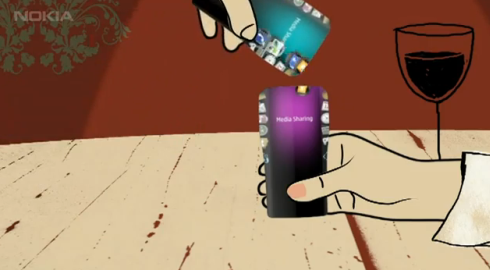
Nokia has been on a roll lately, showing us no less than 3 concepts, some of them showcased at Nokia World 2011. This is the third one actually, Nokia GEM, a device that prides itself with being a handset that was turned into an entire touchscreen. There’s also an interesting comic-book like video in the source link below, in case you want extra info.

Nokia GEM was launched to celebrate 25 years of existence of the Nokia Research Centre and this device is all about the touchscreen it incorporates on its front, back and sides. The back is also interactive, so you can pinch to zoom from the rear, without cluttering the front screen. This function also comes in handy when using maps and probably games too, as proved by the Sony PS Vita.
Senior Design Manager Jarkko Saunamäki is the one who lead the team that created GEM and recently claimed that once you launch an app, for example the camera application, the entire phone will begin to look like a camera. How? Well, there’s an entire image wrapped around the phone, since it’s a whole touchscreen after all. The coolest thing about this device is that it also allows people to carry advertising on the back of the handset when making calls, so they would get a discount on bills. How cool is that? 3D images viewed from all angles are also supported!



We’ve been hearing a lot about Nokia flexible phones lately, with a prototype being even demoed at Nokia World 2011. This may be no Nokia Morph, but it’s surely interesting enough to make us think about the future. And now there’s a new project called the HumanForm, that looks like the pics you see below.

Created by Nokia Design and Nokia Research Center, HumanForm is all about flexibility and bendable phones. The result is a touchscreen device that looks like a thermometer or a feminine accessory, that seems to only fit a vertical row of icons on its small display. The device allows physical manipulation and nanotechnology allows data to float on the screen like liquid.
Thus a flow of social networking info is created and you must know that the entire case of the HumanForm device is a touchscreen, while flexing the handset is also a means of control. Bend to zoom is supported for example, as shown in the video in our source link. A small phone doesn’t necessarily mean small features, keep that in mind… Is this Nokia futuristic design the real future?


[via Yanko Design]

01/11/2011 16:32 par slaytane
Nokia World 2011 brought us the first Windows Phone 7.5 Mango devices from Nokia and now maybe it’s time to start looking for the first Windows 8 tablet made by the Finns. This could be a slate that looks like the device pictured below, a mere render of a tablet inspired by the Nokia N9.
Nokia must be careful here not to make the same mistake it did when trying to enter the market of netbooks. The Nokia Booklet 3G failed miserably because of the price and I really can’t see a solid reason for its purchase. Since Nokia is all about Microsoft these days, why wouldn’t they also join hands in the tablet field?
I know that MS has been trying long and hard to come up with an iPad rival… Thus, now that the Steve Jobs official biography revealed that the iPad was in fact an idea started to tease Microsoft, the Redmond giant has all the reasons to retaliate and the hardware coming from Nokia to be able to do so. Do you give a Nokia Win 8 tablet any chance of survival?
Remember the Nokia Morph flexible concept from 3 years ago? Well, it’s only now that Nokia has started moving to that direction, creating a flexible display device or two, showcased during this week’s Nokia World 2011 event in London. The result can be seen below:

This is the prototype Nokia Kinetic Device, that supports display flexing on the vertical and horizontal axis. You can bend and twist the screen to control the interface, for example bending the display to yourself in order to select stuff or zoom in on pictures. If you’re listening to music you can use the tactile area to navigate, stop or play a song.
There’s still a long way to go till mass production, but at least there’s a prototype to build upon. The curios thing here is that Nokia was shy of detailing the screen technology, so this could mean it’s not the flexible AMOLED we’ve seen on Samsung and Sony’s side for a while now. The viewing angles are also pretty good when it comes to the Nokia flexible concept phone.


01/11/2011 16:27 par slaytane
Before you’re intrigued as to why I’m posting this, let me make this clear: this device is a concept used by Nokia in a video to showcase the NFC abilities of its handsets. Thus, don’t expect the best of design here, just a simplistic unit with a very rounded form factor.
This is a Symbian Belle Nokia model with a curved screen that was spotted in a video running on a Nokia 700, that was demoed recently. This seems to continue the trend started with the Nokia N9, just like the N8 opened the road for devices to follow it. One must also notice that the call/end/menu keys are capacitive, which is certainly new to the world of Symbian.
There’s a speculation that this is actually a qHD display handset, the N8-01, if there is such a thing out there. Also in this leak there’s an interesting service called Nokia AirCloud, making us think of a future solution for working in the cloud entirely, maybe some backup, maybe some Google Docks style action?


