HTC Panache
16/08/2011 04:07 par slaytane
-

HTC Panache
16/08/2011 04:07 par slaytane
Mobile Miscellany: week of July 11, 2011
By Brad Molen  posted Jul 18th 2011 6:00PM

Here's some of the other stuff that happened in the wide world of wireless for the week of July 11, 2011:
- Samsung launched an ad campaign for the Infuse 4G which claims its colors are "so good, they fool Mother Nature." Each ad features a different animal that mistakes the Infuse's Super AMOLED Plus screen for real nature. [via Gottabemobile]
- T-Mobile's MyTouch 4G is now available on Cincinnati Bell as the HTC Panache 4G for $200 with two-year agreement. [via MobileBurn]
- We got a sneak peek at some of Symbian Belle's UI changes, thanks to the refreshed Design Guideline docs on Nokia's developer website. [via All About Symbian]
- Inductive charging battery covers are now available for the HTC Thunderbolt and Incredible 2, Motorola Droid 3, and the LG Revolution. [via Droid-Life]
- Motorola officially announced the Fire, aka XT316. It's a portrait QWERTY handset with Gingerbread and is currently available in China. In the coming months it should work its way to Taiwan, Latin America, and Europe. The XT316 is going for $230. [via Unwired View]
- The popular GroupMe messaging app is now available for Windows Phone and can be downloaded for free in the Marketplace. [via MobileBurn and Gizmodo]
- Romanian carrier Cosmote has launched a 21.6 Mbps HSPA+ broadband service. (thx lonel) [via ZF Business Hi-Tech]
HTC Status
16/08/2011 03:58 par slaytane
-

HTC Status
16/08/2011 03:58 par slaytane
For many smartphone users, a quality keyboard is the only feature that truly matters. These passionate devotees will proudly live and die with their thumbs blazing, and for of all RIM's recent troubles, it's currently floating on a life preserver: a compelling handset with a portrait QWERTY keyboard doesn't exist for Android. The HTC Status ($50 on contract) attempts to succeed where others have failed, and -- if it's any good -- could entice many BlackBerry-toting teens that want a new handheld fixation. They rarely bother with email, as text messages and Facebook reign supreme for communication. To that end, the Status promotes itself as the perfect phone for Facebook users, but is the integration truly useful, or simply a chintzy add-on? More so, can HTC successfully marry Gingerbread with an upright keyboard? Join us after the break to learn whether we "Like" the HTC Status.
Hardware
The HTC Status has a form factor you know well. Measuring 4.5 inches (114.4mm) tall and 2.54 inches (64.6mm) wide, it's a touch larger than your run-of-the-mill 9700 or E73, but at 0.42 inches (10.7mm) narrow, it's thin where it counts. Like the Nexus S, it has a gentle curve -- or bend, depending on how you look at it -- a design quirk that tilts the screen ever-so-slightly toward the user. At 4.37 ounces (124g), it's relatively light, although we immediately noticed that the weight isn't well-balanced, as the top half is appreciably heavier. Fortunately, it felt very comfortable when held securely. On the inside, the Status packs a Qualcomm MSM7227 Turbo SoC with an 800MHz CPU and an Adreno 200 GPU. It supports quadband GSM and features HSPA connectivity over the 850 / 1900MHz bands. There's a wide assortment of goodies here, including 512MB of memory, WiFi (up to 802.11n), mobile hotspot functionality, Bluetooth 3.0, AGPS, and FM radio, along with a compass, accelerometer, and proximity and ambient light sensors. Users will find a 2GB microSD card pre-installed, but much to our frustration, the expansion slot is buried beneath the anemic 1250mAh battery.
The first thing you'll notice is the full QWERTY keyboard stretching across the bottom half of the handset -- that and the dedicated Facebook button, which we'll talk about more in a bit. In many ways, the Status takes its design cues from the HTC Flyer. The face of the phone is largely blanketed in a metallic silver coating, save for the chrome speaker grille up top, a curved white strip along the bottom, and a thick black bezel surrounding the display, which contains four haptic navigation buttons. The silvery finish extends around the back to form a broad strip that showcases an engraved HTC logo and separates the camera pod from the battery cover. Oddly, these upper and lower sections are composed of two distinct white plastics. While the upper portion has an outstanding look and feel that's reminiscent of ceramic, the lower part is woefully thin, which cheapens its attractive satin appearance. To make matters worse, the battery cover is very, very difficult to remove. While the user's manual suggests it can be popped free with two thumbs, we tried this method for ten minutes without success. Instead, HTC should have written the instructions as such:
Sandwich the phone face-down between your palms, squeeze tightly, then push forward without abandon -- the cacophony of key tones is normal, so don't be scared -- just keep forcing it until that damn securely-engineered cover pops free.
Aside from the poorly designed battery door, the Status is well-assembled. It even survived an (unintentional) drop on the hardwood floor completely unscathed. Maybe next time...
Hidden within the chrome speaker grille, you'll discover a green / amber notification light that indicates new messages or a low battery, and there's also a front-facing VGA camera nestled in the bezel. Along the left side of the phone is a short, narrow volume rocker that runs nearly flush with the phone, and while you can press nearly any part of the button to adjust the volume, the rocker feels stiff, with poor tactile feedback. Below that you'll find an exposed micro-USB port. A 3.5mm stereo mini-jack is located up top, positioned to the left of the power / lock button. Around back, a 5 megapixel autofocus camera is paired with an LED flash and a dedicated loudspeaker.
Display
The 2.6-inch (480 x 320) Gorilla Glass touchscreen features approximately 221 pixels per inch. While this is a step below the norm, we still found all but the smallest of text to be quite readable (albeit, marginally blurry). The TFT LCD screen is decently bright, which allowed us to comfortably view the display in direct sunlight. Granted, it wasn't ideal, but we didn't need to run for shade either. While the color saturation diminishes when angled beyond 20 degrees to the left or right, it's significantly better than the EVO Shift 4G we used for comparison.
Keyboard
As for the all-important keyboard, it's quite good. Unlike the never-ending sea of buttons you'll find on the BlackBerry, the Status' island layout allows each domed key to stand separately, and the typing experience is both comfortable and accurate. The buttons are reminiscent of small pebbles, and each key press feels firm and tactile, resulting in a rewarding click. Unfortunately, the underlying panel creates a mushy sound that detracts from an otherwise ideal typing experience. The keyboard integrates a numerical keypad for dialing, along with a dedicated ".com" button and four directional keys that help position the cursor.
Performance and Call Quality
Provided you're not looking to play graphically demanding games, you'll be pleasantly satisfied with the Status' performance. Seriously, you weren't really planning to on honing your Fruit Ninja skills on the little screen, were you? Sure, its 800MHz CPU is no speed demon, but it's doubtful you'll start begging for an upgrade, either. When it comes to the things this phone was meant to do -- browse the internet, play music, poke through galleries, and yes, update Facebook -- you're likely to have a satisfying experience. Unfortunately, the Quadrant benchmark software wasn't able to complete the requisite CPU test, but we've got a host of other benchmarks for your careful scrutiny.
| aBenchmark |
HTC Status |
HTC EVO Shift 4G |
Samsung Nexus S |
| Linpack |
9.6 |
33.7 |
17.4 |
| Nenamark |
36.3 |
41.3 |
51.6 |
| Nenamark2 |
7.4 |
10.6 |
n / a |
| Neocore |
55.6 |
57.1 |
55.6 |
| Sunspider |
10,013 |
4,109 |
5,879 |
After enjoying outstanding call quality on the Wildfire S -- also on AT&T's network -- we had high hopes for the Status. Unfortunately, those hopes went unfulfilled. While voices sounded clear, an inescapable hiss emanated from the phone as soon as we started a call. Even during calls to landlines, our friends' voices seemed distant, hollow, and muffled. Worse yet, calls would frequently cut out, forcing friends to repeat what was said. Fortunately, no calls were dropped, and our friends perceived us very clearly and seemed quite satisfied with the depth of our voice.
Battery Life
Given the small display and relatively pedestrian CPU, we'd hoped the 1250 mAh battery would provide sufficient longevity for web browsing, chatting, check-ins and status updates. Unfortunately, any social-savvy user is likely to overwhelm the lithium-ion cells. One day, we enjoyed an hour of music, and three half-hour blocks of web browsing, Facebook messaging, and good ol' voice chat. During this time, we took approximately a dozen pictures, checked into three establishments via Facebook, and sent a smattering of emails, Facebook status updates, and picture uploads. Ten hours later, we were scrambling for a wall outlet. While the battery will certainly carry you through the day, don't expect it to deliver you through the evening, too. In our standard battery rundown test, we started with a full charge and fresh boot, enabled GPS and WiFi (without connecting to an access point), set the display to 50 percent brightness, configured one push email account, and set Twitter and Facebook to poll every 15 minutes and one hour, respectively. When playing a movie on a continual loop, the handset kept pace for just three hours and thirty minutes, while average runtimes for Android smartphones are nearly twice that
Camera
The five megapixel AF camera is an admirable performer under ideal lighting conditions, and is able to capture a respectable amount of detail, especially when coupled with HTC's tap-to-focus feature. Overall, we were quite pleased with the picture quality, but the camera isn't without setbacks. Unfortunately, if you shoot in direct sunlight, even vivid colors will appear somewhat muted, and bright areas will be frequently overexposed. Meanwhile, pictures taken under artificial lighting appear overly saturated, and proper white balance is often difficult to achieve. The camera also produces an appreciable amount of noise indoors, even at low ISO settings. As you might expect, the sensor performs poorly in low light situations, and creates an unnatural (though vaguely artistic) effect of overexposing lit areas while underexposing dark patches. There's no macro shooting mode either, and we found that you'll need at least four inches of distance between the lens and your intended object for the shot to be halfway usable. The LED flash is certainly capable of illuminating an indoor scene, but you'll need to be cautious of reflective surfaces, as the built-in bulb can easily overwhelm the sensor. Video resolution goes up to 720 x 480, and while the frame rate can't properly convey fluid motion at this setting, it should be adequate for capturing embarrassing situations that are bound for Facebook.
Software
Much to our delight, the Status comes loaded with Android 2.3.3 (Gingerbread). It also features a customized version of HTC's user environment known as Sense 2.1 for Messenger, which retools the familiar UI for the smaller display. While the main screen is quite crowded, many users will likely appreciate the amount of information and content that's immediately accessible from this panel. Rather than the standard weather widget, you'll find a bubble underneath the clock that displays status updates for Facebook and Twitter. Granted, the usefulness here is debatable, but it's certainly cute given the social nature of the phone. There's only five home screens (rather than HTC's standard seven), and the default panel now occupies the leftmost position. The four remaining spaces include widgets for Google search, FriendStream (which aggregates Facebook and Twitter activity), Facebook chat, and an empty panel with a solitary plus icon that's intended to encourage customization. The lock screen is modeled after Sense 3.0, which offers quick access to the dialer, email, camera, and messages by simply dragging the appropriate application onto a ring that's located at the bottom of the display. These icons are also customizable, should you care to replace any with apps of your choosing. Sadly, the notification panel doesn't include the handy Quick Settings menu, which means you must dig through Android's settings to select which radios are enabled.

Seeing that the Status is, after all, a social phone, we were consistently frustrated with the typing experience. Mind you, the hardware is excellent -- we're just griping about software here. As writers, we take pride in our words, and unless something is on fire, it's unlikely you'll find us spelling you're as "youre", or who's as "whos." Since smartphones are supposed to be, you know, smart, we shouldn't ever have to type an apostrophe to form a proper contraction. Sure, this can be resolved by enabling prediction, but then we must contend with astonishing "corrections" such as "Boise" being changed to "noise." We have better things to do than keep tabs on word prediction. With a keyboard this good, our typing is deliberate, intentional, and most of all, accurate. Hence, we need a distinct "Auto Correct" mode that's separate from "Auto Predict." All we're asking for is properly formed contractions. Bonus points for capitalized proper nouns. Just don't make us babysit the prediction engine any longer.

Our pains didn't end with the keyboard software, either. The camera application routinely quit while taking pictures, and while it brought little fanfare -- returning us straight to the HTC Sense home screen -- it desperately needs a remedy. We also noticed there's a dedicated shortcut to the settings menu that should activate by pressing Alt + Space. Unfortunately, unlike the quick access camera button, this link is broken. Worst of all, third-party applications that don't support rotation will force you to hold the phone sideways to read the content. Initially, this was only a minor annoyance, but it turned out to be a huge inconvenience whenever we needed to enter text. Your only option will be typing sideways or viewing your input in an equally awkward manner. Granted, this isn't necessarily HTC's fault, and should serve as a wake-up call to developers, but it doesn't change the fact that all Status owners will be forced to tolerate this inhumane experience.
Facebook
 Of course, no review of the HTC Status would be complete without examining its Facebook integration. Intuitively, many assume that this solitary blue square is merely a dedicated shortcut to the Facebook application. In reality, it's a context-sensitive button that's primarily geared toward sharing status updates and links. By default, a single press opens a dialog for updating your status. (We're sure the pun isn't lost on you). Alternatively, you can write on friend's walls or upload pictures. A long-press on the Facebook button reveals a dialog for checking into nearby establishments, along with the ability to create check-in points for previously unlisted destinations. Tapping the Facebook icon from the web browser allows you to share the article you're viewing -- and provide a thoughtful description, such as: "zomg! LAME!! kthxbai." Sharing pictures directly from the photo gallery works in the same manner, and you can tag friends or provide captions before choosing an album destination. If you're currently a social butterfly who posts updates throughout the day, you might find true value in the Facebook button -- if not, it's unlikely to change your habits. Facebook chat is another primary element of the Status, where a full-screen widget allows you to quickly communicate with other online acquaintances. The instant messaging is incredibly enjoyable to use, and inbound replies were nearly instantaneous. Unless you deliberately sign off, however, you'll appear online and available for chat with friends -- even while you sleep. In other words, even though you'll likely rekindle a few friendships with your new-found availability, you'll probably end up apologizing to just as many contacts that you inadvertently ignored.
Wrap-up
By now it should be obvious that the HTC Status fails to achieve its full potential. Given that it's a device for communication, typing should be flawless, but the software makes it a consistent pain. We hated the battery cover, the battery life is borderline insulting, and there's room for a larger display with greater pixel density, but -- believe it or not -- we'd be willing to forgive these elements if the phone's software felt more polished. We believe HTC will go a long way by simply improving the typing experience, but in order for this form factor to thrive on Android, developers must also rally to support landscape displays in a portrait enclosure. If you're considering the Status as the perfect complement to your Facebook lifestyle, at just $50 on contract, there's still a lot to appreciate. For our part, we're hoping that a better phone is just a software update away.
S5690 Galaxy Xcover
16/08/2011 03:19 par slaytane
-

S5690 Galaxy Xcover
16/08/2011 03:19 par slaytane
Samsung a présenté le Galaxy Xcover, un smartphone tournant sous environnement Android 2.3 Gingerbread avec surcouche graphique TouchWiz.
 Prévu pour le mois d’octobre prochain, le Samsung Galaxy Xcover profite d’une certification IP67 qui assure à son propriétaire une protection totale contre l’infiltration de poussières et une étanchéité totale à un mètre de profondeur durant trente minutes, mais aussi d’un écran LCD 3,65 pouces tactile capacitif multitouch avec traitement contre les rayures.
Propulsé par un processeur cadencé à 800 MHz, il propose outre cela une compatibilité 2G / 3G / Wi-Fi ( avec possibilité de hotspot pour le Wi-Fi ), une puce pour la navigation GPS, une connectivité Bluetooth 3.0 avec gestion A2DP, une sortie audio 3,5 millimètres et un port micro-USB 2.0.
Celui-ci offre enfin un appareil photo numérique 3,2 Mégapixels avec flash LED et géotagging, une webcam 0,3 Mégapixel, un lecteur multimédia multiformat, une boussole électronique, une mémoire interne de 150 Mo et un logement pouvant accueillir une carte microSD / microSDHC d’une capacité maximale de 32 Go.
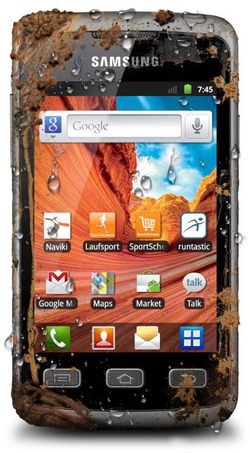
Le Samsung Galaxy Xcover ( cliquer pour agrandir )
Rien n’a filtré au sujet de la commercialisation sur le marché européen pour le moment. Patience donc.
Galaxy S II 4G
16/08/2011 03:08 par slaytane
-

Galaxy S II 4G
16/08/2011 03:08 par slaytane
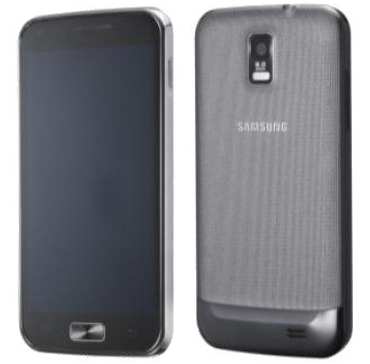
Korean tech news site IT Tong has released details and images of an unannounced Galaxy S II model codenamed “Celox.” Unlike the current Galaxy S II devices, the Celox packs support for 800/1800/2600MHz 4G LTE networks. That means the handset could make its debut in European markets and, hopefully, in the United States with different bands at a later date. The Galaxy S II Celox reportedly offers a 4.5-inch Super AMOLED Plus display, 16GB of internal storage, an 8-megapixel camera and a 2-megapixel camera for forward-facing video chats. It’s unclear when or where the Celox will make its debut at this time, but we’re definitely excited at the possibility of a 4G LTE-enabled Galaxy S II.
I9103 Galaxy R
16/08/2011 03:02 par slaytane
-

I9103 Galaxy R
16/08/2011 03:02 par slaytane
Le constructeur sud-coréen Samsung vient d'annoncer le lancement de son smartphone Galaxy R, également connu en tant que GT-I9103.
Animé par un processeur ARM double cœur nVIDIA Tegra 2 cadencé à 1 GHz, c’est un modèle monobloc aux dimensions 12,6 x 6,7 x 0,9 centimètre pour un poids de 135 grammes qui évolue sous environnementAndroid 2.3 avec surcouche graphique TouchWiz.
Il offre un écran Super Clear LCD tactile capacitif multitouch de 4,2 pouces dans une résolution 400 x 800 pixels, ainsi qu’une compatibilité avec les réseaux 2G / 3G / Wi-Fi pour les communications voix et data. Il propose, par ailleurs, une puce pour la navigation GPS, une connectivité Bluetooth 3.0, une connectique micro-USB 2.0, une sortie audio 3,5 millimètres, une boussole électronique, un appareil photo numérique 5 Mégapixels avec autofocus / flash LED / géotagging, un lecteur multimédia compatible DivX / Xvid et un tuner radio FM avec support RDS. Il met aussi à disposition une mémoire interne de 8 Go et un logement pour cartes mémoire compatible microSD / microSDHC.
À noter, enfin, la présence d’une batterie Lithium-Ion à la capacité 1 650 mAh qui procure jusqu’à 9 heuresd’autonomie en communication et jusqu'à 620 heures d’autonomie en veille.

Samsung Galaxy R ( cliquer pour agrandir )
La disponibilité est prévue au cours du troisième trimestre, à un prix inconnu pour le moment.
500
06/08/2011 18:38 par slaytane
-

500
06/08/2011 18:38 par slaytane
Nokia dévoile un nouveau smartphone sous Symbian Anna avec le Nokia 500, terminal doté, une fois n'est pas coutume chez le fabricant finlandais, d'un processeur 1 GHz.
Englué dans sa transition vers Windows Phone, Nokia n'en continue pas moins de soutenir Symbian et de lancer des terminaux sous cet OS. En ce 1er aoűt, le fabricant dévoile le Nokia 500, un smartphone sous Symbian Anna doté d'un affichage tactile capacitif 3,2" 640 x 360 pixels.
Et alors que le fabricant communique généralement peu sur les processeurs utilisés, il ne manque pas d'indiquer cette fois que sont nouveau smartphone embarque un processeur 1 GHz, alors qu'il s'était jusqu'ŕ présent soigneusement tenu ŕ l'écart de la course aux gigahertz dans les processeurs mobiles.
Smartphone complet ŕ petit prix
Le Nokia 500 se positionne comme un terminal d'entrée / milieu de gamme abordable et dispose d'un APN 5 megapixels au dos. On trouvera ŕ bord 2 Go de mémoire interne, extensible par port microSD ( jusqu'ŕ 32 Go ), les connectivités sans fil WiFi et Bluetooth 2.1, un module GPS ( avec boussole électronique ) et une compatibilité pentabande HSPA pour pouvoir utiliser l'appareil partout dans le monde, le tout dans un format compact ( 111 x 54 x 14,1 mm ) pour ŕ peine 93 g ( le plus léger des smartphones Symbian^3, précise Nokia ).
Si Nokia n'est pas entré dans le jeu des processeurs surpuissants, c'est aussi pour préserver l'autonomie de ses appareils. Le Nokia 500 offre sur ce point entre 5 et 7 heures d'autonomie en conversation, plus de 450 heures en veille ou 35 en lecture musicale continue.
Disponible initialement en coloris noir ou blanc, avant de disposer d'une palette complčte de couleurs, il sera commercialisé ŕ partir du troisičme trimestre 2011 au prix de 150 € HT ( et 199 € TTC pour le marché français ).
Atrix 4G
09/07/2011 14:43 par slaytane
-

Atrix 4G
09/07/2011 14:43 par slaytane
Motorola est bien représenté au salon CES 2011 en dévoilant plusieurs smartphones et une tablette tactile. Le Motorola Atrix, distribué par plusieurs opérateurs mobiles, s'annonce prometteur avec son processeur Tegra 2 dual core et son affichage 4" qHD.
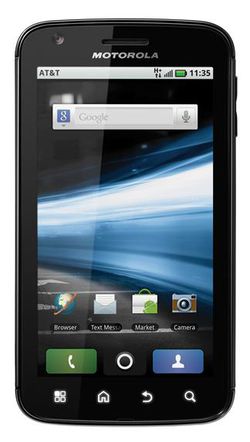 Depuis son revirement vers les smartphones Android, le fabricant de terminaux Motorola ( devenu depuis le 4 janvier Motorola Mobility ) a su surprendre par les performances et les technologies embarquées dans ses produits mobiles.
Il fallait donc aussi faire forte impression au salon CES 2011 de Las Vegas et la société y a dévoilé des terminaux à la pointe du savoir-faire dans l'industrie mobile. Le Motorola Atrix y trône par exemple en bonne place.
Ce smartphone Android 2.2 Froyo ( et surcouche MotoBlur ) se distingue par l'utilisation d'un processeur dual core Tegra 2 de Nvidia, chaque coeur étant cadencé à 1 GHz, avec 1 Go de RAM, et par un large écran 4" qHD ( et verre Gorilla de Corning ) offrant une résolution de 960 x 540 pixels et un codage couleur 24-bit.
Le terminal offre toutes les connectivités sans fil nécessaires ( WiFi, Bluetooth 2.1, GPS... ) et dispose d'un espace de stockage de 16 Go, extensible par un port pour carte mémoire microSHC ( jusqu'à 32 Go supplémentaires ).
Un smartphone...mais aussi presque un ordinateur
Il peut faire office de hotspot mobile et possède la particularité de pouvoir passer en mode " webtop " une fois posé sur son dock : il se transforme alors en ordinateur de substitution et peut faire tourner sur grand écran un navigateur Web Firefox complet au lieu de WebKit.
 On trouvera d'ailleurs des accessoires pour transformer le Motorola Atrix en quasi-ordinateur, avec un dock Multimédia et un "laptop dock ", sorte de compagnon mobile ou de client léger que l'on pourra relier au smartphone.
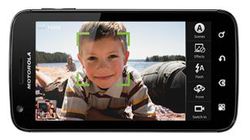
Le Motorola Atrix comprend également un lecteur d'empreintes et un APN 5 megapixels avec double Flash, ainsi qu'un APN en façade pour la visioconférence.
A noter également que le Motorola Atrix ne mesure que 11 mm d'épaisseur ( 118 x 63,5 x 11 mm pour 135 g ) mais embarque tout de même une généreuse batterie de 1930 mAh, procurant jusqu'à 9 heures d'autonomie en conversation et 10 jours en veille.
Le Motorola Atrix est déjà annoncé chez plusieurs opérateurs mobiles ( AT&T aux USA où il est appelé Motorola Atrix 4G alors que c'est un smartphone HSPA+, Bell au Canada, Orange UK... ).
Xoom
09/07/2011 14:37 par slaytane
-

Xoom
09/07/2011 14:37 par slaytane
Qu'est-ce qui rend la tablette Motorola Xoom, sous Android Honeycomb, plus chère que la tablette iPad aux caractéristiques comparables ? Le produit de Motorola a été désossé et livre quelques pistes.
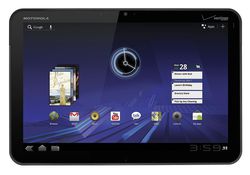 La tablette Motorola Xoom est commercialisée depuis la semaine dernière aux Etats-Unis mais au prix de 799 dollars nue, ou 599 dollars avec un abonnement data chez l'opérateur Verizon US. C'est (un peu ) plus cher que la tablette iPad d' Apple WiFi / 3G avec 32 Go de stockage.
Comme à chaque lancement de produits électroniques, les analystes ont désossé les tablettes pour en évaluer le coût des composants ( la fameuses BOM ou Bill of Materials ) et déterminer qui sont les fournisseurs.
UBM TechInsights évalue à 278 dollars le coût de fabrication brut d'une tablette Motorola Xoom à partir de ses composants, contre 245 dollars pour la tablette iPad la plus proche au niveau des caractéristiques.
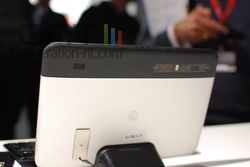 La différence se joue au niveau des APN ( une webcam en façade et un APN 5 megapixels au dos ) qui ajoutent 14 dollars à la BOM mais aussi sur l'affichage qui, en offrant une plus grande résolution, coûte aussi plus cher, d'environ 5 dollars.
Ce dernier argument n'est pas repris par IHS iSuppli, qui a aussi son estimation ( pas encore dévoilée ) et qui fait remarquer que la tablette iPad dispose d'une technologie d'affichage IPS, plus onéreuse. Mais il faut compter aussi des capteurs ( de pression, notamment ) le processeur dual core Tegra 2 de Nvidia et 1 Go de RAM là où l'iPad utilise un processeur ARM Cortex-A8 et 256 Mo de RAM
Un positionnement prix qui intrigue
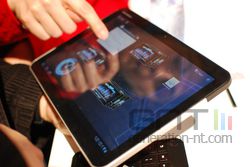 Mais la plupart des analystes se posent la même question : pourquoi Motorola n'a-t-il pas cherché à produire une tablette avec une BOM plus basse, quitte à se passer de certains composants, pour pouvoir concurrencer le premier prix d' Apple et se positionner sur ce critère essentiel ?
Sanjay Jha a indiqué qu'une tablette 7" verrait probablement le jour cette année chez Motorola, tandis que le prix de la Motorola Xoom était lié à la présence d'un modem 4G LTE pour Verizon ( qui n'est pas présent sur les modèles vendus et devra être installé ultérieurement ). La tablette Xoom vise aussi une cible plus professionnelle tandis que la future tablette 7" sera plutôt orientée divertissement.
Le patron de Motorola Mobility a également indiqué que les premiers chiffres de ventes de la Motorola Xoom n'étaient pas mauvais, sans en dire davantage. En Europe, une version WiFi de la tablette Xoom est attendue sous peu.
Droid X2
09/07/2011 14:33 par slaytane
-

Droid X2
09/07/2011 14:33 par slaytane
Après le Droid X dévoilé en juin 2010, Motorola annonce le Droid X2, smartphone Android disposant toujours d'un affichage 4,3" et d'un processeur dual core 1 GHz.
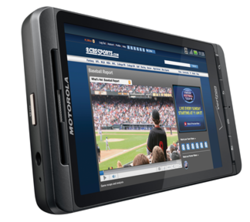 Le lancement du smartphone Droid X2 par Motorola Mobility est parfaitement réglé, un an après celui du Motorola Droid X, et toujours chez l'opérateur US Verizon Wireless.
Ce nouveau modèle en reprend les grandes lignes, avec un affichage tactile 4,3"; cette fois en résolution qHD ( 960 x 540 pixels ), un processeur dual core 1 GHz, avec 512 Mo de RAM, et un APN 8 megapixels avec double flash LED.
Le Motorola Droid X2 conserve son orientation de produit de divertissement multimédia mobile et embarque les connectivités sans fil WiFi ( avec support DLNA et hotspot mobile ), Bluetooth, un module Radio FM, un module GPS et une connectique HDMI.
Divertissement en grand écran mobile
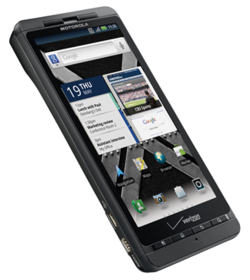 A bord, on trouve 8 Go d'espace de stockage interne ( eMMC ), extensible par un port microSDHC et divers capteurs ( accéléromètre, luminosité, proximité ). Le Motorola Droid X2 sera d'abord commercialisé avec Android 2.2 Froyo, la mise à jour vers Gingerbread étant attendue plus tard.
Etant prévu sur le réseau mobile de Verizon, ce smartphone sera donc compatible CDMA / EV-DO et ne fonctionnera pas sous cette forme sur les réseaux GSM. A noter que le fabricant met en avant ses fonctionnalités pour l'entreprise en termes de sécurité et de gestion de politiques IT.
Il sera commercialisé à partir du 19 mai sur le site de Verizon et disponible en boutiques à partir du 26 mai pour un prix de 199,99 dollars associé à un abonnement sur deux ans.