
Windows Mobile Phone Concept Is Neat, Should Feature Android OS
04/06/2010 16:17 par slaytane


04/06/2010 16:17 par slaytane
This is not the first time that David Turpin designs a Windows Mobile phone, and his previous attempt featured a similar look. However, what’s surprising is that hot QWERTY keypad, packed in such a slim body. This device could easily compete with the XPERIA X1 and T-Mobile G1, but only in case those flat keys offer some sort of feedback.
I cannot help but wonder how Android OS would look like on Turpin’s concept phone… What do you think?

04/06/2010 16:16 par slaytane
Microsoft isn’t all about software, as it’s shy when it comes to announcing a Zune phone, but never too serious to get a laughter from its fans. The oPhone laughs in the face of the iPhone and it’s quite a hilarious device, as you can’t take it seriously, although some of the ideas and technologies it uses are quite nice.

This is a fold out variable device, that uses three different surfaces for input and a circular display. It runs Windows Mobile and Microsoft claims that once you open the handset, its three-wing shape will make it a perfect boomerang. One of its surfaces includes a full keyboard, another one includes a music player control and a wheel control plus a few buttons.
Okay, now back to Windows Mobile 7, Microsoft!

[via InsideMicrosoft]

04/06/2010 16:13 par slaytane
Many are still waiting for the Google Phone, not the Android one, but THE GPhone, while others are dreaming of a Xbox Phone and finally many are craving the Zune Phone. Well, we’ve got a concept to satisfy our tech hunger, the Zune Contact phone created by Adam Huffman.
It’s an incredibly thin device with a 5 megapixel camera, a touchscreen and a pretty crowded interface. Its internal memory is 32 GB and in case you’re wondering, that big white button is a thumb rest, as unbelievable as it may seem.

04/06/2010 16:10 par slaytane
While CeBIT 2008 is in full bloom in Germany, Microsoft’s got an internal event of its own, the TechFest fair, an excellent opportunity for showing off new technologies and concepts like the Microsoft Lucid Touch. This prototype device can be controlled with the aid of the user’s fingers, which will “multi-touch” (is this a new verb?) the device from behind.

As you control this device, you’ll be able to still see your fingers, due to the pseudo-transparency technology. You’re not using a semitransparent handset, instead you’ll be seeing a image of your hands which creates such an illusion. Keep in mind that Lucid Touch supports multi-touch input, so you’ll be using all your fingers to play some fancy RTS on your tablet.
This great concept comes as a response to the people frustrated by small screens and thick fingers, getting in the way of the devices’ user friendliness.

04/06/2010 16:07 par slaytane

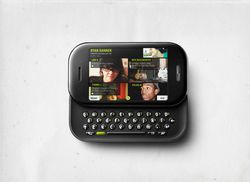 Ces contenus peuvent être stockés dans un espace unique ( The Spot ) avant d'être envoyés vers le contact désiré ou partagés. Les Kin font également appel au stockage en cloud, permettant de générer du contenu bien au-delà de la capacité mémoire physique des terminaux.
04/06/2010 16:03 par slaytane
Après des mois de spéculations, Microsoft donne de la consistance à ce qui était jusqu'à présent connu sous le nom de Projet Pink en dévoilant les Windows Phone Kin ( Kin One et Kin Two ), qui ne sont autres que les mobiles aperçus sous les nom de code Pure et Turtle. Mais attention, Windows Phone ne veut pas forcément dire Windows Phone 7.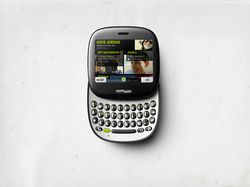 " Nous avons créé Kin pour les gens qui vivent pour être connectés, pour partager, s'exprimer et cultiver les relations avec leurs amis et leur famille. Cette génération " sociale " veut plus de son téléphone. Kin est le lieu idéal pour fournir le matériau dont vous avez besoin à propos des gens qui vous tiennent le plus à coeur " indique Robbie Bach, président de la division Entertainment and Devices de Microsoft.
03/06/2010 17:38 par slaytane
Nokia seems to be having a field day. The Nokia E73 Mode just went official and just as expected, it's headed to T-Mobile USA. Reading through its spec sheet though, there are plenty of similarities between the E73 and E72. A staple of the E7x phones is the portrait QWERTY keyboard and surprise, surprise... it's available on the Nokia E73 Mode too. Running the Symbian S60 3rd edition was also to be expected - the capable connectivity too. The Nokia E73 Mode comes with quad-band GSM and 3G with HSPA (using T-Mobile's frequencies of course). Active noise cancellation ensures a better audio during voice calls and there's video call support too. It also features Wi-Fi, Bluetooth and A-GPS, but the software side of the connectivity is equally important. The business-minded Nokia E73 Mode packs support for Microsoft Exchange servers and IBM Lotus Notes Traveler along with support for all popular public email services. There's also high-end stuff like VPN support and UMA (voice calling over Wi-Fi) and also hardware accelerated encryption and remote wipe functionality. Ovi Maps with free voice-guided navigation and Lonely Planet guides are included as well. The Nokia E73 Mode packs a 5MP camera with LED flash - to photograph your travels. The retail package includes a 4GB microSD card and a carrying pouch. The car stand in the picture isn't a standard accessory though. The E73 Mode uses the same Li-Po battery as the E72, which has enough juice to last 16 days in 2G and up to 22 days in 3G mode (13 and 6 hours of talk time respectively). The E72 manages to squeeze out some longer standbys but it's still pretty impressive. The Nokia E73 Mode is expected to become available on June 16th. T-Mobile don't mention a price though. Anyway, all this sounds good and all, but it's almost exactly the same as the Nokia E72. Here's a head-to-head comparison.
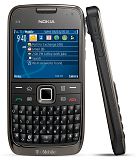
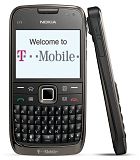
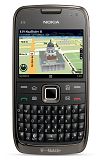
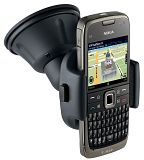
Nokia E73 Mode for T-Mobile. Unfortunately, the car stand isn't a standard accessory

17/05/2010 21:17 par slaytane
Pas sûr que vous ayez été sages mais allez, voici quand même les photos de l’OVNI de Kohjinsha : le DZ !
Dans la suite du billet, quelques remarques sur ce netbook à deux têtes de 10.1″ embarquant un processeur AMD Congo MV40 @ 1.6GHz, un DD de 160Go, le Wifi, le Bluetooth…

17/05/2010 21:10 par slaytane
 Répondant au nom de Wildfire, il s'agit d'un terminal à la finition épurée, au format monobloc et aux dimensions compactes 10,7 x 6 x 1,2 centimètre.
D'un point de vue plus technique maintenant, celui-ci offre une compatibilité avec les réseaux mobiles 2G / 3G / Wi-Fi, un grand écran LCD tactile capacitif multipoint 3,2 pouces en 262 144 couleurs et dans une résolution 240 x 320 pixels avec accéléromètre pour la rotation de l'affichage et capteur de proximité pour la coupure de la fonction tactile, un dispositif de pointage optique et des touches dédiées à la recherche en ligne.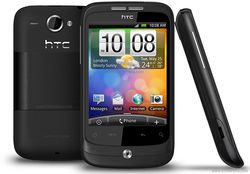 Son équipement comprend également une puce GPS, une boussole électronique, un appareil photo numérique avec capteur 5 Mégapixels, autofocus, flash LED, détection des sourires et géotagging, un lecteur multimédia, un tuner radio FM avec fonction RDS, une sortie casque 3,5 millimètres, une mémoire interne de 512 Mo, un emplacement pour les cartes mémoire microSD / microSDHC d'une capacité maximale de 32 Go, un port microUSB 2.0 et une connectivité Bluetooth 2.1.
Le tout carburant à l'aide d'un processeur Qualcomm MSM 7225 à 528 MHz épaulé par 384 Mo de RAM et alimenté par une batterie Lithium-Ion 1 300 mAh à l'autonomie pour le moment inconnue.
Fraîchement annoncé, le smartphone HTC Wildfire sera rendu disponible dans le courant du troisième trimestre 2010. Reste à en découvrir le prix.

10/05/2010 12:51 par slaytane
Nokia wanted to find out what its fans think about the design trend followed by its future smartphones, so it allowed the people to speak out and define the next-gen handset. It was all done thanks to the “Design by Community” project, allowing fans to vote on the characteristics of the future Nokia smartphoe. Unwired View created a mockup starting from the public’s preferences:
Apparently, the fans desire a 10mm thick device with a 4 inch capacitive touch display, multitouch, a uniblock aluminum body and multitasking. The Finns will deliver the official concept this month and we have to mention that the public also wants WiFi 802.11 n/b/g on the handset, plus an open source OS, USB 3.0 and HDMI.
Dolby surround sound, an 8 megapixel camera with 4X zoom and HD video recording were also mentioned, as well as support for multiple operating systems (Symbian and MeeGo at the same time). We’ll publish the official Nokia concept phone when they release it, but in the meantime, we think that Unwired View’s idea is pretty good.