
Heartbeat, a Smartphone that Shares Stories on the Go
10/05/2010 12:50 par slaytane


10/05/2010 12:50 par slaytane
We’ve found a new and prolific designer, Jakob Kumar, who created a very interesting Nokia smartphone concept. Dubbed Nokia Heartbeat, the device helps users communicate by “telling stories”. This handset’s shape is linked to its fluid and capture-based interface. Basically, the smartphone is “sucking up” information, capturing videos, photos and text.

The content can be viewed and edited on the device and then published online. Social networking features are also supported, as well as messaging and calling (obviously). What’s really interesting is the interface concept on Nokia Heartbeat, staying true to the handset’s name. This UI revolves around the idea of a heart’s pulse: music bars, hearth graph, lying detector. Such mechanisms were used to replace lists and galleries…

There’s also a stylus in the mix, useful for editing content, while the volume and lock buttons on the phone are easily accessible. As you can see in the images of the Nokia concept, Heartbeat uses a wheel for moving around menus, like some compact cameras on the market today. There’s also a “composer” included in the UI, allowing you to merge images, sound and video into a story.
This idea is pretty simple and original, but it would be better for a PMP, a MID or a revolutionary camera, rather than a smartphone… or maybe even a console. What do you think?


10/05/2010 12:47 par slaytane
Antonio De Rosa has created a couple of pretty interesting iPhone concepts before, but now he’s trying something new: an Apple watch. The iWatch design is pictured below and it comes with an alumium body, WiFi support and Bluetooth among others.

There’s also a RSS Reader on board, 16GB of internal memory, a weather forecast system and the possibility of connecting the watch with the iPad or iPhone via WiFi. Probably the most appealing feature of the Apple watch concept is the LCD projector it incorporates, able to show images (hopefully video, too) anytime and anywhere.
Great idea and hopefully we’ll see it turned into reality some day…


05/05/2010 14:58 par slaytane
The BlackBerry Slider was absent from rumor-land for a while but it has returned along with some more photos. The BlackBerry Slider 9800 is shown running the BlackBerry OS 6, so it's still on track to becoming the first RIM phone with the new OS. The photos are quire poor - but still, they confirm that the BlackBerry Slider (probably not its real model name) is running BlackBerry OS 6, though (quite expectedly) a pre-release version. BB OS 6 was expected, along with some other interesting bits - touchscreen, but no SurePress, and a 5MP camera with something called "liquid lens technology". This leak neither confirms nor denies any of that. They do show the BlackBerry Slider 9800 running on Rogers, so we're sure to get a GSM version. We still don't know when the Slider is coming out though. However, if it will really be the first device to run OS v6, then the BlackBerry Slider 9800 should come out in Q3 at the earliest(when BB OS 6 is expected).


New photos of the BlackBerry Slider 9800 • old photos are clearer

05/05/2010 14:53 par slaytane

We’re not so surprised by this as we did get word from RIM that the BlackBerry Pearl 9100 could mainly be for domestic US users and the Pearl 9105 (with T9) for overseas (including Europe and why not Germany). Even though there is no word yet, there is a possibility that they will put out the 9100 but we wouldn’t know, and so far we’ll just go by the rumor we received from RIM. So Vodafone Germany has just put up on their site that the BlackBerry Pearl 9105 will be coming soon. Over the next week, we expect to hear carriers announce both the Pearl 3G and Bold 9650 as RIM officially announced them earlier this week at WES. It doesn’t seem like we’ll be able to pre-order this time but stay tuned for more as Vodafone Germany announces an official launch date.

05/05/2010 14:45 par slaytane
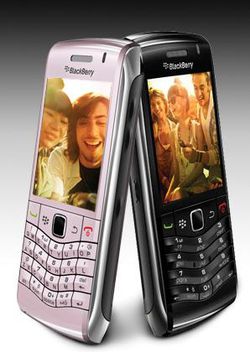 La gamme Blackberry Pearl a aidé le fabricant Research in Motion a passer du statut de producteur de smartphones professionnels à celui de concepteurs de smartphones polyvalents utilisables par le grand public.
Critiqué par les observateurs pour un certain manque de visibilité sur sa stratégie d'innovations, Research in Motion est attendu au tournant. le Blackberry Pearl 3G, et le Blackberry Bold 9650, également annoncé, ne suffiront peut-être pas à rassurer mais ils viennent compléter deux gammes qui marchent plutôt bien.
Le Pearl 3G est présenté comme " le smartphone Blackberry le plus compact jusqu'à présent ", avec des dimensions de 108 x 50 x 13,3 mm pour 93 g, et comme un modèle élégant qui ne lésine pas pour autant sur les fonctionnalités, notamment ne supportant la connectivité UMTS / HSDPA.
Caractéristiques
Il fonctionne sous Blackberry OS 5.0, possède un affichage de résolution 360 x 400 pixels et un clavier à deux lettres par touche associé à la technologie de saisie Suretype, maintenant son caractère de smartphone de messagerie. Animé par un processeur 624 MHz associé à 256 Mo de RAM et 256 Mo de mémoire Flash ( et port microSDHC en plus ), le Pearl 3G dispose d'un trackpad optique et d'un APN 3,2 megapixels au dos.
Il dispose des connectivités WiFI 802.11 b / g / n et Bluetooth 2.1, ainsi que d'un module A-GPS, en plus de sa compatibilité quadribande GSM / GPRS / EDGE et tribande UMTS / HSDPA. Sa batterie 1150 mAh offre jusqu'à 5 h d'autonomie en communications GSM, 5h30 en UMTS et jusqu'à 18 jours en veille.
D'abord tourné vers le grand public, le Pearl 3G sera proposé en plusieurs coloris. Deux variantes sont proposées : le Pearl 3G 9100 avec clavier complet et le Pearl 3G 9105 avec clavier alphanumérique traditionnel. Prix et date de disponibilité ne sont pas encore connus.

05/05/2010 14:42 par slaytane
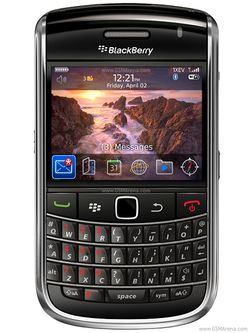 Fonctionnant sous environnement BlackBerry OS 5.0, le BlackBerry Bold 9650 annonce une compatibilité avec les réseaux mobiles GSM, GPRS, EDGE, UMTS, HSDPA et Wi-Fi b / g, une version CDMA EV-DO Rev A étant également annoncée et spécifiquement tournée vers l'Amérique du Nord.
Il propose également un écran LCD 2,4 pouces affichant 65 536 couleurs dans une résolution 480 x 360 pixels, un trackpad tactile, un clavier AZERTY pour la messagerie, une puce pour la navigation GPS, un appareil photo numérique 3,15 Mégapixels avec autofocus et flash, un lecteur multimédia avec support DivX et une sortie audio 3,5 millimètres pour le branchement des écouteurs
À cela s'ajoutent un emplacement pour les cartes mémoire microSD / microSDHC à la capacité maximale de 16 Go, un connecteur microUSB 2.0 pour les transferts de données en filaire, une connectivité Bluetooth 2.1 pour les transferts de données en sans-fil et une batterie Lithium-Ion à la capacité 1 400 mAh.
Le smartphone BlackBerry Bold 9650 sera commercialisé aux Etats-Unis dès le mois de mai 2010, pour un prix non communiqué. Il sera lancé à partir du troisième trimestre 2010 sur d'autres marchés.

30/04/2010 13:19 par slaytane
En attendant, peut-être, une tablette un peu plus ambitieuse, Sony a commencé la distribution du Dash, sa tablette domestique, au moins aux États-Unis. On peut voir l’appareil sur des présentoirs dédiés dans certains Best Buy :
Rappelons que l’engin dispose d’un écran capacitif de 7 pouces (800 x 480), le wifi b/g, une sortie audio, 256 Mo de RAM, le support du MP3, WMA, WMV9, VC-1, MPEG4, ainsi qu’à une boutique de 1 000 applications type mini-jeux, horoscopes, etc.

30/04/2010 13:15 par slaytane
Jumper a dans ses cartons une nouvelle tablette, la JK01-TT et contrairement à ses collègues, on peut l’admirer en vidéo !
Techniquement parlant, cette tablette devrait (oui, “devrait” vous le verrez dans la suite plus bas) embarquer un écran de 10,1 pouces, un processeur Intel Atom N450, 2 Go de RAM, 250 Go de stockage, un APN de 2 mégapixels, trois ports USB, une sortie HDMI, le Wifi b/g, le support de la 3G, le tout sous Windows 7. Pour 535€, on repart même avec un clavier, une souris et un socle, c’est cadeau, ça leur fait plaisir.
NDLR : on est tatillon mais leurs specs sèment le doute car avec un processeur N450 (Pine Trail), il devrait y avoir un chipset video GMA 3150 or il est écrit GMA 950, ce qui devrait aller avec un processeur N270/N280 (Diamondville)… Prudence donc !

30/04/2010 13:12 par slaytane
Après le N8, Nokia planche sur un nouveau modèle moins haut de gamme mais pas moins intéressant, le C2. L’appareil bénéficierait en effet d’un écran rotatif, rien de mois, qui lui permettrait d’afficher un clavier plus complet des deux bords.
Ce mobile d’entrée de gamme embarquerait un APN de 2 mégapixels, un écran de 240 x 320 sans doute pas tactile, et c’est à peu près tout ce qu’on suppute pour le moment.

30/04/2010 13:09 par slaytane
Ah c’est malin, c’est bien le moment d’avouer que Fusion Garage avait fait quelques erreurs avec la Joojoo, maintenant que l’engin est disponible dans une partie de l’Europe (lire cette dépêche) !
La société admet ainsi que son produit est loin d’être un «tueur d’iPad», que l’interface n’est pas forcément au top niveau et que le retard accumulé pour la sortie officielle a pu rendre confus certains utilisateurs.
En ce qui concerne l’interface, Fusion Garage promet une mise à jour rapide, qui apportera également la possibilité de lire des vidéos HD en plein écran.